Pages

Pie Crust Cookie Search

Showing posts with label Italian. Show all posts

Thursday, November 11, 2021

Spicy Italian Sausage with Polenta


Another use for all the cherry tomatoes from my garden.


print

Spicy Italian Sausage with Polenta


Adapted from Cook's Country Magazine
Serves 4-5

1 batch of cooked polenta kept warm (cheesy grits can be subbed, see original recipe)

1 pd sweet Italian sausage, either in bulk or with casings removed
1 onion, chopped fine
approx 3/4 pd cherry tomatoes (the recipe calls for 10 oz but I used nearly 1 pd)
2 T chopped jarred hot cherry peppers or pepperoncini plus 1 T of the brine, see note below
3/4 c chicken broth, see note below

Over medium-high heat, cook sausage and onion in a large skillet until lightly browned. Break up the sausage as it cooks. When cooked, remove from the skillet and hold the mixture in a bowl. Retain 1 T of the fat in the skillet and discard the remainder.

Place the tomatoes in the hot skillet and cook without stirring. Allow them to start to brown and then stir in the chopped peppers. Continue cooking for a few minutes until tender. Add the broth, brine, and the reserved sausage mixture. Check for seasonings and add salt if needed. Cook approximately 5 minutes the sauce thickens until slightly and serve over the polenta. Top with basil chiffonade and/or grated parmesan cheese.

Notes:

I believe using pepperoncini will create a less spicy sauce which may be just what some diners need.

I added some crushed fennel seeds because the brand of sausage I used was light on that spice.

I used water and a few bay leaves as a substitute for chicken broth because I didn't want the added salt. 

Sunday, October 10, 2021

Chicken with Sausage, Tomatoes, and Black Olives in a Slow Cooker

This past summer I had huge amounts of tomatoes when I came home from a long trip in Europe. It was too hot to roast and freeze them and to complicate matters I didn't have an oven anyway. So I looked for slow cooker recipes that used healthy amounts of tomatoes. This is one. 


print

Chicken with Sausage, Tomatoes, and Black Olives in a Slow Cooker


Adapted from THE MEDITERRANEAN SLOW COOKER by Michele Scicolone

Serves 6-10

2 T olive oil
6 sweet Italian sausages (about 1 pd)
1 medium onion, chopped
2 cloves garlic, minced
pinch of crushed red pepper
1/2 c dry red wine
1 28-oz can crushed tomatoes, or 4 cups chopped fresh tomatoes run through the food processor
6 whole chicken legs, skin removed if preferred, or 12 thighs, boneless or bone-in
salt and freshly ground pepper
1-1 1/2 c pitted Kalamata olives, halved
3 T chopped fresh flat-leaf parsley, or basil sliced in chiffonade, or chopped fresh oregano 

If you are using chopped fresh tomatoes, you may want to cook them by themselves in the slow cooker for about an hour on high to help break them down more completely.

Heat the oil over medium heat in a skillet and place the sausages into the hot oil and cook them until they are brown on all sides. Place them in a large slow cooker. In the oil, cook the chopped onion until it is softened. Add the garlic and the crushed red pepper. Cook for a minute and add the wine. Bring to a boil but turn down to a simmer and cook for about a minute.

Transfer the onion mixture to the slow cooker and add the crushed tomatoes if you haven't used fresh tomatoes. Place the chicken pieces into the sauce in the slow cooker. Turn them over and spoon some of the sauce over the top. Cover and cook on high for an hour and then for approximately 3  hours on low until the chicken is very tender. The meat may start to separate from the bones. You can also test the meat with a thermometer and make sure it is at least 165F.

Check the sauce. It should be about the texture of a spaghetti sauce. If not, remove the chicken and sausage and place the sauce into a shallow saucepan or a skillet and cook over medium heat until it is reduced to your preference. Return the sauce, chicken, and sausages to the slow cooker, stir in the olives, and return to heat. Check for seasonings and add more salt and pepper if needed.

Serve the chicken and sausage garnished with one or the other of the fresh herbs. I believe it would be good accompanied by pasta or polenta, as well.  


Friday, August 14, 2020

Second Best Pesto Method


Most of the experts I read indicate they think the best way to make pesto is in a mortar and pestle. 


print

Second Best Pesto Method 


The source is an article written by Ella Quittner in Food52.com in which she reports on testing she undertook to find the best method to make pesto. She based her recipe on one found in a book published last fall Pasta Grannies by Vicky Bennison. (I just love the title of that book!)

Yields about 1/3 c or enough for 3/4 pound of pasta depending on your preference.


1 clove garlic
1/2 teas salt (rock salt can provide grinding traction, but coarse kosher is fine, as is table salt but use less table salt)
3-ish cups basil leaves (tender, young leaves if possible unless you grow your own)
3-ish T Italian pine nuts, untoasted, or chopped walnuts since true Italian pine nuts are expensive and you may not have them in your pantry
1/3 c mildly flavored extra-virgin olive oil
a heaping 1/3 c grated cheese (can be a mix of parmigiano reggiano and pecorino romano)


Put all ingredients minus the cheese and olive oil, into a wide jar (a quart-size container or quart mason jar or a pickle jar; anything slightly wider than the immersion blender). With the immersion blender, blend as finely as possible. Stop and scrape the sides and the inside of the blender occasionally. You'll end up with a paste (I guess that's where it gets its name). 

Drizzle the olive oil in as best you can while still running the blender (or simply pour it in and then run the blender). Add the cheese and continue blending. I ended up with a nearly smooth product. 


Notes:

I found it simpler to blend when I coarsely chopped the basil leaves and used something wider than a quart mason jar. Even a saved quart yogurt container works here and it's much easier to scrape out the finished pesto. When I tripled the recipe, I did it in a medium sized bowl.

I once saw a suggestion for using pecans. I haven't tried that yet but I liked walnuts more than I thought I would. 

I wanted the pesto to stay a bit greener so I added a half cup of parsley to the basil. I didn't notice much change in flavor.

I have enough basil I will need to freeze some of this for the winter. When researching, I found both pros and cons for freezing it with the cheese already mixed in. I ended up freezing mine without cheese and will just stir it into the pasta when I mix in the pesto. I find it easy to freeze in a quart-size freezer bag and then I can break off what I need.

Tuesday, December 13, 2016

Polenta, a Third Way: Slow-cooker Method

I love polenta so much I've already posted a couple of recipes for it. I prefer it to pasta. A cook can be negligent while cooking this recipe since it only needs to be stirred a couple of times. It's my new favorite method.


print

Polenta, a Third Way: Slow-cooker Method


Cooking in a slow-cooker is not quite as predictable as cooking in an oven. Mine will be different than yours. The first time you make this start checking to see if much of the water has been absorbed before the 2-hour point. If it has go ahead and stir it and finish cooking as directed. 

Adapted from:  The Mediterranean Slow Cooker by Michele Scicolone
Serves 6-8

3 c water
2 c chicken broth, vegetable broth, or more water
1 c coarsely ground yellow cornmeal or cornmeal for polenta, not instant
1/2-1 teas salt
1 T unsalted butter
1/2 c grated Parmegianno-Regianno
Freshly ground pepper to taste

Stir the water, broth, cornmeal, and salt together in a slow cooker. Cover and cook on high for around 2 hours. In my slow cooker, it takes only 90-100 minutes. (Watch it carefully until you've learned how your slow cooker behaves.) Stir well, cover, and cook on low for 30-60 minutes more or until the polenta is thick. I used the warm setting for the final hour.

When the polenta is thick and creamy, stir in the butter and the cheese and stir until melted and well combined. Serve immediately.

Monday, April 18, 2016

Quick Risotto Primavera

I always think of my friend Susie and her old neighborhood in Brooklyn when I eat risotto. On a visit years ago, she took me to the restaurant Noodle Pudding, which had a daily risotto special. Here is a quick, meatless version for the spring asparagus season.


Print

Quick Risotto Primavera


Adapted from The America's Test Kitchen Quick Family Cookbook
Serves 4

1 1/2 c Arborio rice
5 c chicken broth (divided)
4 T unsalted butter (divided)
1 onion, chopped fine
2 garlic cloves, minced
1/2 c vermouth
1/2 lb asparagus, no thicker than 1/2 inch at the bottom, trimmed and cut into 1-inch pieces
1/2 lb crimini mushrooms, cut into 1/2-inch chunks
1 c frozen peas, thawed
2 oz Parmesan cheese, grated (1 c), plus extra for serving
salt and pepper

In covered bowl, microwave rice, 3 1/2 c broth, and 2 T butter until rice is softened and most of liquid is absorbed, 10-16 minutes.

Chop the onion. Melt 2 T butter in a medium or large saucepan over medium-high heat. Cook onion in butter until softened, 3-5 minutes. Turn down the heat a bit if the onion starts to burn. Add minced garlic and stir, then add wine and cook until reduced by half, about 3 minutes. While onions are cooking, trim the asparagus and cut it into 1-inch pieces. Also, trim the mushrooms and cut into 1/2-inch chunks.

Stir in rice mixture, remaining 1 1/2 c broth, asparagus, and mushrooms. Simmer, stirring constantly, until rice and vegetables are tender, 5-8 minutes. Add 1/2 c water if the vegetables aren't done at 5 minutes. Stir in peas and Parmesan, and cook for an additional minute while the peas heat. Season with salt and pepper and serve with extra Parmesan.

Note: This recipe seems quite flexible. The original called for vegetable broth instead of chicken, white wine instead of the vermouth, and yellow squash instead of the mushrooms. I used what I had on hand, and it turned out beautifully. Shredded rotisserie chicken would be a nice addition for meat lovers.


Monday, November 9, 2015

Basil Pesto

Basil is one of my favorite things about summer--it means sunshine and being outside in the garden, smelling my back porch herbs on the way out the back door. Pesto is a great way to preserve basil for enjoying in the winter; I usually eat it with pasta, but you can also use it as a sauce for fish, chicken, or vegetables.

Thanks to the generosity of a friend who planted large basil patches this year, I recently made and froze three pints of pesto. Three pints! That will evoke summer for quite some time.

Here's what my mom has to say about basil: "I don't know if anyone younger than 40 realizes just how rare pesto or basil were in the American diet until the 80s and 90s. I never saw a fresh basil leaf, let alone a plant, as a child. I only knew of dried basil. When we visited the states from Bahrain I became aware that Grandpa Hayes grew lots of herbs in his St. George garden. Shortly after we arrived back in Virginia in 1991, I took a library class on herbs and started to grow herbs every year. I can hardly imagine how boring our food was before we had fresh herbs all the time."


Print

Basil Pesto


1 c basil leaves
1/4 c olive oil
1-2 garlic cloves, depending on size
1 T pine nuts or almonds
5 T Parmesan cheese, shredded
1-2 T melted butter (optional)

A good blender makes a difference here. Blend the basil and oil into a paste. Add garlic and nuts, then blend until smooth.

If using immediately, add cheese and butter and blend again.

If freezing, leave out the cheese and butter and stir it in when you are about to serve. You may have to estimate just how much to add since you'll only use a portion, but it won't hurt if you get too much of either ingredient.

Notes on freezing containers: We have frozen pesto in a number of containers, including ice cube trays, glass jars, and plastic bags. Bags are our favorite, because it's easy to break off the needed amount of pesto. Ice cube trays are a pain for a couple of reasons: the pesto cubes are hard to remove from the tray, and also one pesto cube is rarely enough. Jars work, but it's hard to remove the amount of pesto you need without defrosting the jar. So bags are best. Lay flat to freeze, and break off what you need.

Sunday, November 8, 2015

Bruschetta with Roasted Cherry Tomato, Rosemary and Onion

Although it is November and most Americans are thinking about cooking turkeys and pies, the long summer meant that Betsy and I only recently finished harvesting our gardens. Now I am working to deal with tomatoes (red and green), chard, last green beans, sweet potatoes, and the last of the raspberries. Today I came across this recipe which helped me use most of my cherry tomatoes.


Print

Bruschetta with Roasted Cherry Tomato, Rosemary and Onion


Adapted from Epicurious
Serves 6-10, depending on if it's a meal or a snack

For the topping:

1/2 c olive oil
3 large garlic cloves, minced
3 teas finely chopped fresh rosemary, although I think you could use dried (only 1 1/2 teas)
3/4 teas salt
1 teas freshly ground pepper
2 pounds cherry tomatoes (I used a variety of types), halved
1 small onion, sliced or chopped
2 teas fresh lemon juice
ricotta cheese, optional
baby arugula, micro greens, or parsley, optional


Mix the oil, garlic, rosemary, salt, and pepper in a large bowl. Add the tomatoes and onions and stir to coat. Let stand for 5 minutes or so. Line a rimmed large baking sheet with parchment paper and dump the tomato mixture on to the paper. Spread the mixture out so tomatoes are in a single layer. 

Place in the center of your oven and turn on the oven to 250F. (Unless your oven's preheat feature is so hot you think it may burn the mixture--then preheat.) Cook for several hours until the tomatoes have become wrinkly and have reduced in size. The cooking sauce should have thickened noticeably and will be similar to tomato sauce. Remove from oven and stir in lemon juice. 

Allow to cool a bit and dig in or allow to rest until completely cool. Spread on top of prepared bread and enjoy. If available, top with a dollop of ricotta cheese and some greens and serve. 

This can be frozen so you can enjoy the flavor of tomatoes in the wintertime.

For the bread:

Toast slices of baguette or ciabatta. Rub with a cut piece of garlic while still hot.  

Notes: 

I have found that tomatoes can be roasted at almost any heat. I did it at this low heat today so I could leave the kitchen and go dig sweet potatoes. If you roast them at a higher temperature (as high as 425F) you will have to shorten the time and check more often to keep them and the onions from scorching. 

To make this more of an open face sandwich lay a piece of prosciutto on the toast before adding the other ingredients.


Wednesday, October 28, 2015

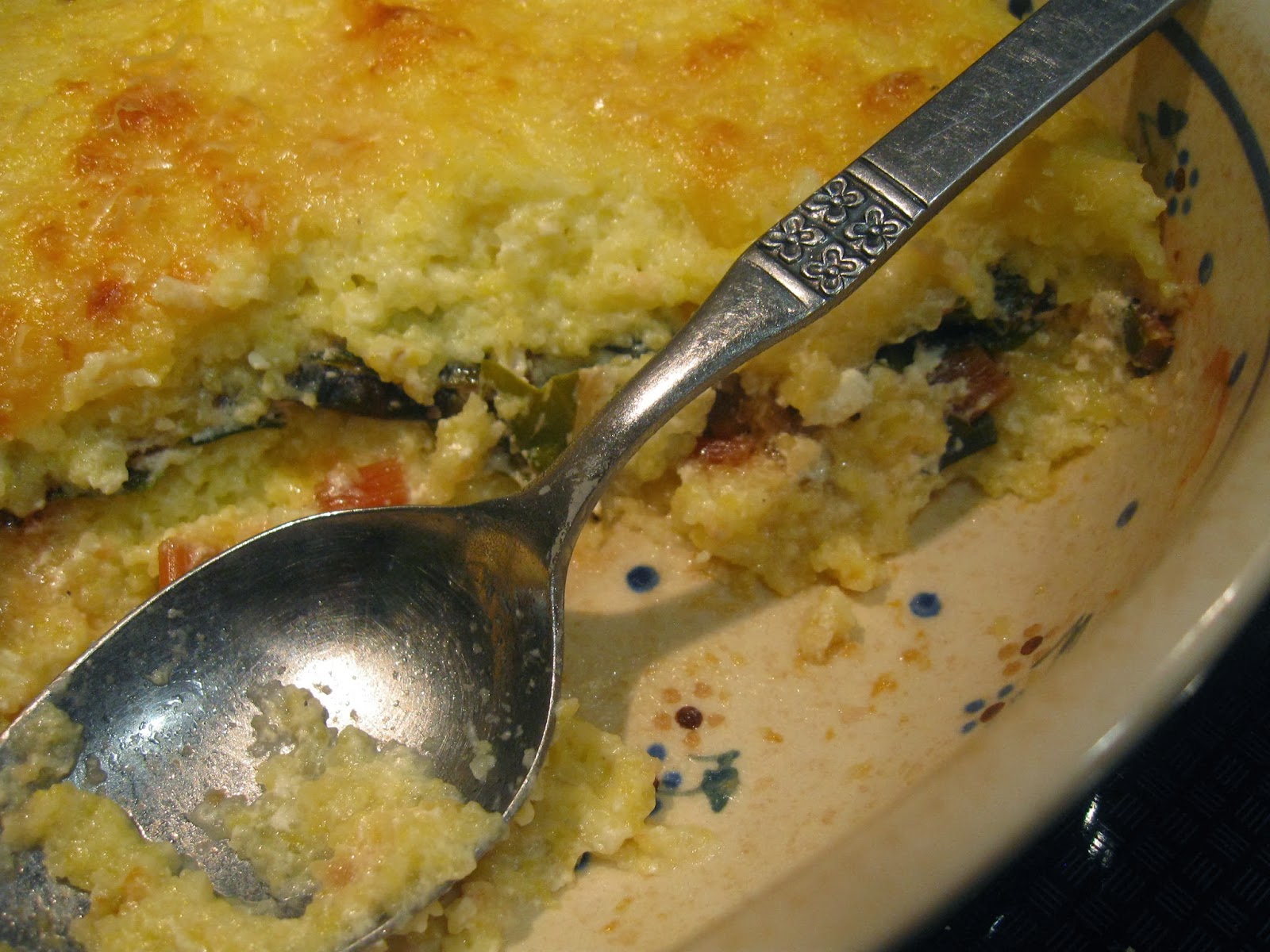
Baked Polenta with Cheese and Swiss Chard

Here is a versatile casserole which can serve as a side dish, a meatless main dish, or a light meal on its own. I'll admit that mozzarella cheese called for didn't taste quite cheesy enough for me. I plan to substitute some sharp cheddar or asiago next time (I'll let you know how that goes). I think you could add some crumbled cooked Italian sausage to the chard if you don't want to go meatless.


print

Baked Polenta with Cheese and Swiss Chard


Adapted from The Washington Post which adapted it from The Best Casserole Cookbook Ever  by Beatrice Ojakangas
Serves: 6-8 as a side or 5-6 as a main dish

For the chard layer:

1 T olive oil
4 large cloves garlic, minced
1 bunch Swiss chard, stems and leaves separated and coarsely chopped (2 to 2 1/2 c--but I used more like 4 c)
salt and pepper
1 T water

For the polenta:

2 c milk (at least 2 %)
1 1/2 c water
1/2 teas salt
1 c polenta (you may substitute corn grits or stone-ground cornmeal, don't substitute instant polenta)
1/4 c freshly grated Parmesan cheese
1 T unsalted butter
1 c shredded cheese, mozzarella for mild flavor, medium or sharp cheddar or asiago for more flavor
1/3 c sour cream

Preheat the oven to 400F when you start making the polenta. 

For the chard:

Heat the oil in a large skillet over medium heat. Add the garlic and cook, stirring, for 30 seconds, until fragrant; add the stems from the chard. Season lightly with salt and pepper, and stir to combine; add the water, cover and cook for 2 minutes, then add the leaves. Cover and cook for about 5 minutes, until the leaves are wilted.  Remove from the heat, uncover and let cool. Taste and add salt and pepper as needed.

For the polenta:

Combine the milk, water, and salt in a large saucepan over medium-high heat. Bring to a boil, then reduce the medium-low heat and slowly whisk in the polenta. Cook, whisking constantly, for about 5 minutes. Then let it cook, stirring frequently, until the mixture has thickened to the consistency of mashed potatoes. Add 2 T of the Parmesan along with the butter and the mozzarella cheese to the polenta, stirring until well incorporated.

Spread half of the polenta mixture in a buttered  2 1/2- to 3-quart casserole dish. Then spoon the chard mixture evenly on top. Spread the sour cream in as smooth a layer as you can. Carefully cover the layers with the remaining polenta. Top with the rest of the Parmesan cheese. Bake, uncovered, for 20-25 minutes until the top is golden.

This can be assembled a day before baking, but I advise you let the dish sit out of the refrigerator for an hour before putting it in a hot oven. Add about 5 minutes to the baking time.

Saturday, May 2, 2015

Buttered Green Pasta and Asparagus with Basil

Here's a recipe that highlights the asparagus season.


Print

Buttered Green Pasta and Asparagus with Basil


Source:  The Italian Vegetable Cookbook by Michele Scicolone
Serves 8

4 T unsalted butter, divided
1/4 c chopped scallions
2 pds asparagus, trimmed and cut into 1/2 in. pieces
salt and pepper to taste
1/4 c water
1 pd spinach pasta (of course, regular pasta can be substituted)
1/2 c basil, cut in chiffonade (rolled and thinly sliced)
1/4 c chopped flat-leaf parsley
3/4 c freshly grated Parmesan cheese

Bring a large pot of water to a boil.

Meanwhile, melt 2 T of the butter in a large skillet. Add the scallions and cook about 2 minutes. Add the asparagus, salt and pepper, and the water. Cover and cook at medium heat until the asparagus is crisp-tender, about 5 minutes.

When the water boils, add about 1 T salt and add the pasta to the pot and cook until al dente. Saving some of the pasta cooking water in a bowl or measuring cup, drain the pasta.

Add the cooked pasta to the skillet with the asparagus and add the remaining butter, the herbs, and toss well. Add some of the reserved pasta water to the pasta if it seems dry. Add half of the cheese and toss. Serve; passing the rest of the cheese to diners.


Saturday, October 4, 2014

Corn Risotto

In my region, we are just about done with corn-on-the cob season; darn it. This is the last thing I made with fresh corn. I think it could be made with a high quality frozen corn, but I haven't done it so I can't be sure. I imagine that some of the nice crunch from fresh corn would be lost.

This would probably be prettier with yellow corn rather than white.
Print

Corn Risotto


Most recipes for risotto, including this one require a lot of attention while stirring in the small increments of liquid. Cook's Illustrated Magazine has a technique for avoiding the more labor intensive method. Check it out.

Source: The New York Times
Serves: 4-6

This recipe calls for making a stock out of the corn cobs which might seem like it would take too long. However, when I made it the stock simmered away as I gathered ingredients and prepped before beginning. I felt the extra effort worthwhile since the homemade stock intensifies the corn flavor. If you prefer to streamline, low-sodium chicken broth would taste great, too.

For the stock:

2 corn cobs (kernels cut off and saved for risotto)
1 onion, quartered
1 carrot, cut into 1-inch pieces
1 celery rib, cut into 1-inch pieces
Dark green leaves from 1 leek (save the white and light green)
2 cloves garlic, smashed
1 teas salt
1 teas whole black peppercorns
6 c water

Combine all ingredients with water in a large saucepan. Bring to a boil over high heat. Reduce to a simmer and cover; let cook for 30 minutes. Strain through a fine-mesh  strainer. Add enough water to bring liquid back to 6 cups. Keep warm.

For the risotto:

2 T unsalted butter
1 leek, white and light green parts, rinsed and finely chopped
1 teas kosher salt or 3/4 teas table salt
1/4 teas pepper, freshly ground if you have it
1 c arborio rice, worth looking for because other rices just aren't starchy enough
1/2 c dry white wine (see note)
6 cups hot corn stock or chicken stock
1 1/2 c raw corn kernels (cut from approximately 2 years of corn)
1 c grated Parmesan cheese
1/4 c heavy cream
2 T minced chives (optional)
2 T basil, cut in very thin strips, (or chiffonade)

Melt 1 T butter in a saute pan or large saucepan over medium low-heat. Add leek and cook, stirring occasionally, until softened but not browned. Add salt and pepper. Stir in rice and cook while stirring, until grains look slightly translucent.

Pour in the wine and cook, stirring, until it has been absorbed, a couple of minutes.

Add a 1/2-3/4 c (or a ladle full) of hot stock to the rice mixture and cook, stirring constantly, until the rice has absorbed all the liquid. Continue cooking while stirring continuously, adding another portion of stock whenever the risotto looks dry. When half the stock has been added, stir in the corn. (If you use frozen corn, you may want to wait until 3/4 of the stock has been added.) Continue cooking until all of the stock has been incorporated and corn is tender. The rice should be creamy and tender with a little resistance to the bite.

Turn off the heat and stir in the Parmesan and remaining tablespoon of butter. Cover and let stand for 5 minutes. If it has thickened, you can add a small amount of hot water or stock to loosen it.

Whip the cream until it holds stiff peaks. Stir the risotto and adjust seasoning if needed. Immediately before serving, stir in the chives, if using, then gently fold in the cream. (To tell the truth, I'm not sure what purpose is served by whipping the cream before stirring it in. I predict that stirring in liquid cream would be just as tasty a bit faster. Serve topped with basil.

Note: If you prefer to keep your cooking alcohol free, make a substitute such as this: mix 3 parts white grape juice with 1 part white wine vinegar. Of the various suggestions, I believe this sounds best.

Monday, September 30, 2013

Polenta, Two Ways

It's hard for me to believe I didn't discover polenta until 10 years ago. I never saw it on a menu at an Italian restaurant and certainly never heard it mentioned. I adore polenta and am glad to have come across it, even later in my life. I think some cooks have avoided it because old recipes instructed cooks to stir for 45 minutes or so. That isn't necessary, although it should be cooked slowly at a very low temperature to let the flavors develop (except for the microwave method, also included below). Apparently it is a traditional peasant food; versatile, rather inexpensive, and fairly quick to prepare.


Corn ground for polenta. For more info see this: http://food52.com/blog/3698-cornmeal-vs-grits-vs-polenta-vs-masa


Print

Stove-top Polenta


Adapted from What We Eat When We Eat Alone by Deborah Madison and Patrick McFarlin
Serves 4-6, in spite of coming from a book about single dining

1 cup uncooked polenta, not instant
1 teas salt
4 c water
butter
grated cheese

Bring 4 cups water to a boil. Gradually stir in the polenta in a slow steady stream, then add the salt. Lower the heat to medium if you are cooking over gas or to low if you are cooking on an electric stove. Stir until the polenta has absorbed enough water to make an even mass, more or less. Lower the heat even more, to the lowest setting. At this point you can leave it alone, stirring just now and then to make certain it isn't sticking. It should be cooked for at least 30 minutes to have the best texture and flavor. The longer it cooks after that, the better. (I find it usually takes me 30-45 minutes to prepare a topping so if I start the polenta first, everything is ready at the same time.) Once done, add 1 T salt and 1/2 c grated parmesan cheese. Other cheeses, especially left over odds and ends may be used. According to Madison, fontina and mozzarella are good as are Gorgonzola or other blue cheeses. Taste to check the salt; stir in more, if needed.

At this point, spoon polenta on your plate and top with a meat sauce, braised greens, sauteed mushrooms or serve with chicken or pork. There are plenty of suggestions on the internet. Also see the note accompanying Italian Braised Green Beans. 

See notes below.

Print

Microwave Polenta  


Adapted from cooksillustrated.com
Yields 3 1/2 cups

1 c medium grind cornmeal or polenta 
3 1/2 c water 
1 teas table salt 
pepper to taste

In a 2-quart Pyrex measuring cup, covered with plastic wrap, microwave cornmeal, water, and salt at 100% power for 6 minutes. Uncover and stir thoroughly, then continue to microwave at 100% power until polenta is creamy and fully cooked, 5 to 6 minutes longer. Stir in pepper.

Stir in 1-2 T butter and 1/2-3/4 c parmesan cheese. Check for seasonings and serve. 

Notes:

If you leave out the cheese, polenta can be a tasty breakfast with fruit and a bit of cream. (I suppose it wouldn't be bad if the cheese is left in. You choose.)
 
When polenta cools, it becomes rather solid. You may use it as left overs in the solid form. Cut into pieces and heat in olive oil (this has a tendency to pop, a little like popcorn, but it is tasty). 


Friday, September 27, 2013

Italian Braised Green Beans

Before the growing season is over I must share one more method for using those older, tougher green beans that have hidden from the harvester until they are too big to miss. Those who don't garden may not run into these beans, although sometimes supermarket produce departments offer beans that look considerably past their prime. This recipe may be useful to us all. Let me point out that the beans will resemble canned beans in color but will be superior in flavor and texture. Don't be afraid to try something that isn't "crisp-tender."

My well-used copy of the book, Vegetables Everyday by Jack Bishop, is the source for this recipe, correctly titled "Braised Green Beans with Tomatoes, Olives, Capers, and Basil." I must admit I feel annoyed with recipe titles that list every ingredient. So I changed the title; rather too broadly, I fear. Bishop himself muses that it should be called "Green Beans Puttanesca."


Print

Italian Braised Green Beans


Adapted from Jack Bishop's Vegetables Everyday
Serves 4 as a side dish

1 T extra-virgin olive oil
3 medium garlic cloves, minced
1 pound green beans, ends removed
4 tomatoes, canned or fresh, chopped, and juice from the can to equal 1 c or 1/2 c water
12 large Kalamata olives, pitted and sliced
1 teas drained capers
1 T minced fresh basil leaves
Salt and pepper to taste

Heat the oil in a sauce pan or a saute pan. Add the garlic and saute for 1 minute. Add the beans and stir them well with the oil and garlic. Add the tomatoes, olives, and capers and bring the liquid to a boil. Add some salt (approximately 1/2 teas) and pepper; if you use fresh tomatoes you'll have to add more salt. Reduce the heat to medium-low, cover, and simmer until the beans are quite tender but not mushy. Stir a few times while the beans simmer.

For a side dish, remove the cover from the pan and cook to evaporate the remaining tomato liquid. Stir in the basil and check seasonings; serve immediately.

Note:

The other night, I used this as a topping for polenta and was pleased with the results. However, I advise doubling the tomatoes for use as a sauce and skip the evaporating step.  

If you want to make this more puttanesca-like, add a pinch of red pepper flakes for more heat.

Monday, September 9, 2013

Pasta with Tomato and Almond Pesto (Pesto Alla Trapanese)

This recipe is a fabulous use of home grown cherry tomatoes, although it's still quite good with cherry and grape tomatoes from the grocery store year round. I find that these little varieties are the best option for off-season tomatoes.The original recipe called for a stemmed, seeded, and minced  small pepperoncini instead of the red wine vinegar, but the red pepper flakes are spicy enough for me.


Print

Pasta with Tomato and Almond Pesto (Pesto Alla Trapanese)


Adapted from Cook's Illustrated

1/4 c slivered almonds
12 oz cherry or grape tomatoes (about 2 1/2 c)
1/2 c packed fresh basil leaves
1 medium garlic clove, minced
1/2 teas red wine vinegar
salt
pinch of red pepper flakes
1/3 c olive oil
1 lb pasta, preferably linguine or spaghetti
1 oz Parmesan cheese, grated (about 1/2 c), plus extra for serving

Toast almonds in a small skilled over medium heat, stirring frequently, until pale golden and fragrant, 2-4 minutes. Cool almonds to room temperature.

Process cooled almonds, tomatoes, basil, garlic, vinegar, 1 teas salt, and red pepper flakes in food processor until smooth, about 1 minute. Scrape down sides of bowl with rubber spatula. With machine running, slowly drizzle in oil, about 30 seconds.

Meanwhile, bring 4 quarts water to boil in large pot. Add pasta and 1 T salt and cook until al dente. Reserve 1/2 c cooking water, drain pasta, and transfer back to cooking pot.

Add pesto and 1/2 c Parmesan to cooked pasta, adjusting consistency with reserved pasta cooking water so that pesto coats pasta. Serve immediately, passing Parmesan separately. 


Friday, August 23, 2013

Caprese Salad for Two

I adore this salad and must include it because each year I have to wait 8 months before I eat it in celebration of the arrival of "good" tomatoes. Caprese and BLT's are the best things about summer. In 2006, Leon moved ahead to New Mexico while I stayed alone in Virginia to prepare the house for selling. We had a large group of healthy tomato plants. For two months, at least, I ate Caprese Salad, BLT or Greek Salad in rotation. Not once was I bored. A web search for this salad will bring up beautiful variations on serving, but what is necessary are vine ripened tomatoes and fresh basil. Here in USA, especially in rural towns, it isn't easy to find really good mozzarella but, in this case. the cheese is a foil for the flavors of tomato and basil.

Print

Caprese Salad for Two


This is a throw together recipe there are really no measurements. Of course, this salad can be made for any number of diners.

About 3 handfuls of cherry tomatoes, halved (color varieties optional)
About 1 T extra virgin olive oil
a little fresh lemon juice (1 teas), optional
salt and pepper to taste
About 1 large handful mozzarella balls or cubes
1-2 handfuls of fresh basil leaves, torn, or cut into chiffonade

Place halved cherry tomatoes into a bowl. Drizzle with olive oil and generously sprinkle with salt and freshly ground black pepper. If necessary add a little more oil.  Let sit for 10 minutes while juices accumulate in the bowl. Stir in lemon juice and then stir in the cheese; let rest for 5 minutes. Stir in the basil leaves.

When I make this with tomato slices, I place them on a plate and drizzle with oil and top with salt and pepper. Letting it rest while the tomatoes release some liquid yields what I consider the best part of the salad--the salty, oily, juice. I don't let this go to waste (the juices are sopped up with bread after serving or somebody licks the plate). I place slices of cheese on top of the tomatoes and then basil leaves. You can drizzle more oil on the cheese or the basil. Be generous with your seasonings and with the basil. Eat as much of this salad as you can because November is just around the corner!

Saturday, August 17, 2013

Pasta, Potatoes, Green Beans, and Pesto

A wood-fired pizza place opened up in one of the suburbs of Brussels soon after we moved away from the area to Germany. We lived only two hours away and often made the trip back to Belgium. Sometimes we stopped at this little cafe. The thin crust pizza was great here but I found I also relished a dish of pasta, potatoes, and pesto. When I saw this recipe which includes green beans (which nearly overwhelm me each summer) I knew I had to add it to my repertoire.


Print

Pasta, Potatoes, Green Beans, and Pesto


Adapted from: cooksillustrated.com
serves 6-10 

1/4 c pine nuts 
3 garlic cloves, peeled and coarsely chopped
1 pd large red potatoes, peeled and cut into 1/2-inch pieces 
salt and pepper
12 oz green beans, trimmed and cut into 1 1/2-inch lengths
7 T extra virgin olive oil
2 c fresh basil leaves
1 oz parmesan cheese, grated (1/2 c)
1 pd pasta (gemelli, penne, linguini)
2 T unsalted butter, cut into 1/2-inch pieces and chilled
1 T fresh lemon juice

Toast pine nuts and garlic in 10-inch skillet over medium heat, stirring frequently, until pine nuts are golden and fragrant and garlic darkens slightly, 3 to 5 minutes. Let cool. 

Bring 3 quarts water to boil in large pot. Add potatoes and 1 T salt and cook until potatoes are tender but still hold their shape, 9 to 12 minutes. Using slotted spoon or a spider skimmer, transfer potatoes to rimmed baking sheet. (Do not discard water.)

In the same pot cook the green beans until they are tender and using the slotted spoon (or spider), transfer them to the baking sheet with the potatoes.

Finally, add the pasta to the boiling water and cook, stirring often, until al dente. While pasta is cooking make the pesto:  process basil, parmesan, oil, pine nuts, garlic, and ½ teaspoon salt in food processor until smooth, about 1 minute.

Just before draining, reserve a couple of cups of the pasta water. Drain the pasta and return it to the pot. Add butter, lemon juice, pesto, 1¼ cups reserved cooking water, and ½ teaspoon pepper and stir vigorously with rubber spatula until sauce takes on creamy appearance. Stir in the potatoes and green beans. Add additional cooking water as needed to adjust consistency and season with salt and pepper to taste. Serve immediately passing more grated parmesan.

Note:

I've made a fairly large range in the serving amount estimation. I usually find that servings for pasta recipes are  quite large. Before you serve this for company, you may want to try it to find out how many servings it yields for your family.

Tuesday, July 23, 2013

Three Granitas


I suppose I first learned about a granita from Alton Brown's show Good Eats. A granita is an Italian frozen dessert and can be made of any number of sweetened liquids including juices, herbal teas, wine, and coffee. A granita is a cooling dessert in the summer but much more enjoyable than a snow cone, because one can avoid the heavy sweet syrup squirted on the ice. It is much more elegant (and flavorful) than a popsicle. Try one of these and if you like it, you can find many more recipes on the internet.

Note: the larger the pan you use, the shallower the liquid will be and the faster it will freeze, so if you use a 9X13 pan, check it earlier, rather than later. In addition, the pan can be glass, metal, or plastic, for that matter.
 
I found the following recipe in a book I picked up at a library sale. It allows me to enjoy the best part of a rootbeer float; the crystals last much longer than they do in a the rootbeer.


Print

Rootbeer Granita


Source:  Cakes and Cowpokes by Wayne Harley Brachman
Yield: lots, enough for a party, or keep covered in the freezer to enjoy over a month or so

1/4 c plus 2 T  (3/8 c) water
3/4 c sugar
3 12-oz bottles rootbeer or 36 ounces of rootbeer from a large bottle

Heat all ingredients in a saucepan over medium heat until the sugar is dissolved. Remove from heat and cool to room temperature. Pour mixture into a 9X13 pan, and place in the freezer and let rest for about 45 minutes. Take a fork and scrape the frozen portions on the edge into the middle of the pan. Repeat scraping about every 30-45 minutes until all you have is frozen bits of rootbeer, rather flaky and grainy, hence the name granita. Serve with vanilla ice cream.


________________________________________________________________________________

If you want a less assertive and acidic flavor than you get from lemon juice or zest, use lemon verbena, an under-appreciated herb. It is a perennial in my garden, growing in a protected, warmer spot. It's leaves are so tough one can't really chop them like parsley, basil, or mint, but it's best to infuse their flavor in hot liquid. It also makes a great herbal tea, iced or hot.


Print

Lemon Verbena Granita


2 large handfuls lemon verbena leaves, rinsed clean
the peel of 1 lemon, removed with a vegetable peeler--just the yellow part
2/3 c sugar
1 1/2 c boiling water
6 ice cubes

Pour the water over the lemon verbena leaves, lemon peel and sugar. Stir to dissolve the sugar and leave to steep for 15 minutes. Strain the liquid through a fine mesh strainer and stir in the ice cubes. When they have melted pour the liquid into an 8X8 or a 9X13 pan and place in the freezer. 

Allow to freeze for 45 minutes. Scrape frozen portion away from the sides into the center and replace in the freezer. Continue scraping every 30-45 minutes until there are no liquid portions. 

This can be served as is or with a dollop of creme fraiche or Greek yogurt, sweetened or plain.


_________________________________________________________________________________


Print

Coffee Granita


Adapted from:  Alton Brown's Good Eats
Serves 6

2 c lukewarm espresso or strong black coffee, decaf is fine
1/2 c sugar
1-2 T coffee flavored liqueur, optional
1 teas orange or lemon zest

Combine all ingredients and stir until sugar melts. Pour into a 9X13 pan and place in freezer. Using a fork, scrape the ice crystals that have formed on the sides of the pan and pull them to the center. Return to the freezer and repeat every 30-45 minutes until all is frozen. At that point, fluff the crystals with a fork and allow to "dry" in the freezer for another 30 minutes or so. Scoop into glass bowls or goblets and top with barely sweetened whipped cream with a few thin curls of lemon or orange zest, if desired. 

Friday, May 3, 2013

Stuffed Shells

This was a favorite in our family when the kids were teenagers. The recipe was given to me by a neighbor who lived through the woods from us in Grafton, Virginia. She'd been there only a few months by the time we moved but she was kind enough to make this for us while we were packing out.


Print

Stuffed Shells


1 jar of spaghetti sauce or a quart of homemade sauce
1 box jumbo shells, cooked according to directions—see note

Mix the following together:

1 (16-oz) container low-fat cottage cheese
2 eggs
1 teas salt
1/4 teas pepper
1 T finely chopped parsley
1/4 c frozen chopped spinach, let it thaw and squeeze excess liquid squeezed out
1/4 c grated parmesan cheese (or parmegiano reggiano)
3 c shredded mozzarella cheese (reserve 1 c cheese to sprinkle on top)

Spread enough sauce in baking dish to generously cover bottom (about 1/2 inch deep).  Fill shells; place in sauce. Spoon remaining sauce over shells and cover with foil. Bake at 350F for 35 minutes. Remove foil, spread reserved cheese on top and bake for an additional 5-10 minutes.

Note from Colette: Usually a box of shells is too much for the filling.  Using a tablespoon to fill the shells, I use approximately 28 shells. If I cook a whole box, I increase the filling ingredients by about half and use 1 1/2 quarts of sauce.

Thursday, April 25, 2013

Spring Vegetable Risotto


I didn't discover this Italian comfort food until about 10 years ago and I'm sorry I didn't become acquainted sooner.  There are numerous variations and I haven't run into a variety I haven't liked. This version is particularly nice at this time of year.

Print

Spring Vegetable Risotto


Source:  Cook's Illustrated Magazine
Serves 4-5

To make this dish vegetarian, replace the chicken broth with vegetable broth.  Onions can be substituted for the leeks but use 1 roughly chopped medium onion (1 cup) as a substitute for the leek greens in the broth and 2 minced medium onions (2 cups) in the risotto. At the end of cooking, you may have up to a cup of broth left over.

For the Gremolata:

2 T minced fresh parsley leaves, stems reserved
2 T minced fresh mint leaves, stems reserved
1/2 teas finely grated zest from 1 lemon

Combine ingredients in small bowl and set aside.

For the Risotto:

1 pound asparagus, tough ends snapped off and reserved, spears cut on bias into 1/2-inch thick pieces
2 medium leeks, white and light green parts halved lengthwise, washed, and sliced thin (about 4 cups), and
2 cups roughly chopped leek greens, reserved
4 c low-sodium chicken broth
3 c water
5 T unsalted butter
Salt and ground black pepper
1/2 c frozen peas
2 medium garlic cloves, minced or pressed through garlic press (about 2 teas)
1 1/2 c Arborio rice
1 c dry white wine
1 1/2 ounces grated Parmesan cheese (about 3/4 cup), plus extra for serving
2 teas juice from 1 lemon

Chop tough asparagus ends and leek greens into rough 1/2-inch pieces. Bring chopped vegetables, reserved parsley and mint stems, broth, and water to boil in large saucepan over high heat. Reduce heat to medium-low, partially cover, and simmer 20 minutes. Strain broth through fine-mesh strainer into medium bowl, pressing on solids to extract as much liquid as possible. Return strained broth to saucepan; cover and set over low heat to keep broth warm.

Heat 1 T butter in large Dutch oven over medium heat. When foaming subsides, add asparagus spears,  a pinch of salt, and pepper to taste. Cook, stirring occasionally, until asparagus is crisp-tender, 4 to 6 minutes. Add peas and continue to cook 1 minute. Transfer vegetables to plate and set aside.

Melt 3 T butter in now-empty Dutch oven over medium heat. When foaming subsides, add leeks, garlic, 1/2 teas salt, and 1/2 teas pepper. Cook, stirring occasionally, until leeks are softened, 4 to 5 minutes. Add rice and cook, stirring frequently, until grains are translucent around edges, about 3 minutes. Add wine and cook, stirring frequently, until fully absorbed, 2 to 3 minutes.

When wine is fully absorbed, add 3 cups hot broth to rice. Simmer, stirring every 3 to 4 minutes, until liquid is absorbed and bottom of pan is almost dry, about 12 minutes.

Stir in about 1/2 cup hot broth and cook, stirring constantly, until absorbed, about 3 minutes; repeat with additional broth 3 or 4 times until rice is al dente. Off heat, stir in remaining tablespoon butter, Parmesan, and lemon juice; gently fold in asparagus and peas. If desired, add up to 1/4 cup additional hot broth to loosen texture of risotto. Serve immediately, sprinkling each serving with gremolata and passing Parmesan separately.

Notes from Colette:

I recommend that you use Parmigiano Reggiano if you can swing it. Using the stuff in the can would seriously compromise the flavor.