Pages

Pie Crust Cookie Search

Saturday, February 25, 2023

Tomato Rice Soup with Caramelized Onions

I have a quite a collection of tomato soup recipes, considering how I detested it as a child. Of course, I was served only canned soup, so I don't blame my younger self. Here's the latest addition. The caramelized onions add texture and sweetness, while the rice makes it heartier than some.  


print

Tomato Rice Soup with Caramelized Onions


Source: Milk Street
Serves 4-6

1 T olive oil
1 large yellow onion, halved and sliced thinly
1 teas white sugar
kosher salt and ground black pepper
1 teas dried thyme
1/2 c long-grain white rice, rinsed and drained (see note below if you prefer brown rice)
1 14-1/2 oz can whole peeled tomatoes, crushed by hand
1 quart chicken broth or vegetable broth
1/2 c parsley or basil leaves, chopped
optional basil pesto or grated Parmesan cheese, or both

Over medium flame, heat oil in a large saucepan or medium Dutch oven until it shimmers. Stir in the onion, sugar and half a teaspoon salt and pepper. Cook until the onion is well browned and quite soft, stirring occasionally. Place half of the cooked onion in a small bowl and set aside.

Add the thyme to the onion in the pan and cook for an additional 30 seconds. Stir in the rice, tomatoes and juices and broth. Turn heat to medium high and bring the soup to a simmer. Reduce the heat to medium and continue cooking, covered, until the rice is tender around 20 minutes. Stir from time to time. 

When the rice is cooked, take the soup off the heat and stir in the parsley. Taste it to check for seasoning and add more salt and pepper if necessary. Top each serving with some of the onion and drizzle with oil. Or add either of the optional garnishes.

Notes:

The magazine indicates you can use short grained rice if that's what you have although authors preferred long grain white. I made mine with brown rice and it needed twice the amount of cooking time. 

I think I'll caramelize 2 onions next time, particularly if I let them get quite brown. One isn't enough for all the servings of the soup and leftovers are easy to use.


Saturday, February 18, 2023

Skillet Pumpkin Cornbread

Here's a good way to sneak in a bit of extra vegetables. Although the bread actually looks more orange than this photo, don't be surprised that the pumpkin doesn't make a marked change in flavor. I find this quite tasty but it doesn't have the same height as my usual cornbread. One benefit of the added pumpkin is that it keeps the bread moist for several days after baking.


print

Skillet Pumpkin Cornbread


Yields one 9" cornbread

1 c pumpkin canned pumpkin puree
1 c low-fat milk
2 T olive oil
1 T mild honey
2 eggs
1 1/2 c ground yellow cornmeal, ideally stone ground, but not necessarily
1/2 c AP flour
1 T baking powder
1/2 teas baking soda
3/4 teas salt
1 T unsalted butter


Preheat oven to 400F. Place inside a 9" cast iron skillet or a 2-qt baking pan or a 9" round cake pan.

Place the pumpkin puree, milk, olive oil, honey and eggs in a bowl or large liquid measuring cup and whisk until combined. 

Combine the cornmeal, flour, baking powder and soda and salt in a large bowl. Stir the wet ingredients into the dry and mix but don't overmix.

Remove the pan from the oven and drop the butter in. When it has melted, brush the sides with the melted butter and pour the excess into the batter. Mix it in quickly and scrape the batter into the hot pan. Return to the oven and bake for 30-40 minutes until a cake tester comes out clean. 

The original recipe instructs bakers to let the bread cool for 20 minutes. I've not been able to wait that long.


Portuguese-style Sweet Potato Buns

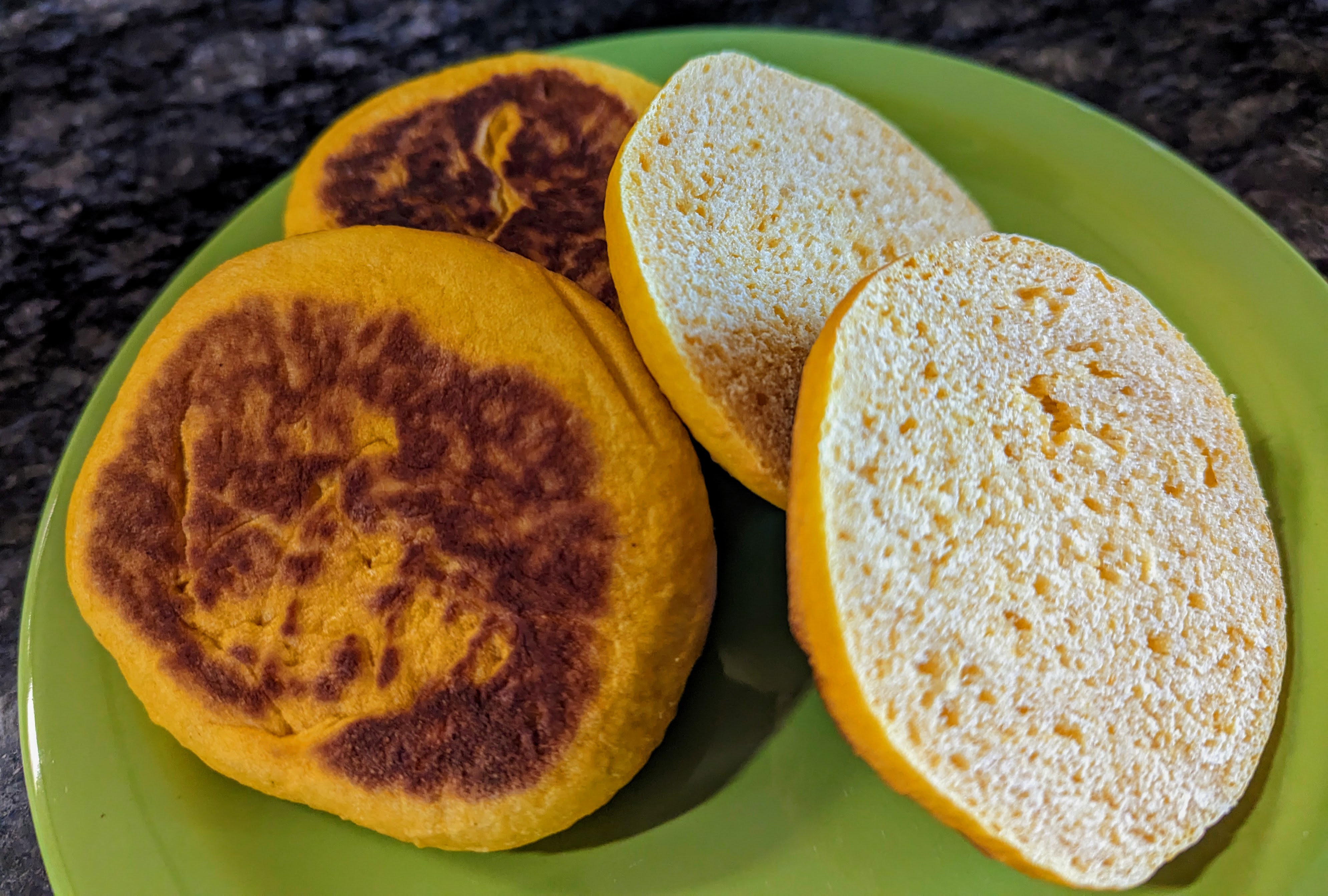
I don't quite know what to call these because they look a little like English muffins (but their inner texture is quite different); they feel like they would make a sturdy burger bun (but the color is unconventional); and they aren't really a dinner roll. Nomenclature aside, these colorful breads were the favorite part of one family meal over the Christmas holiday, especially with the chive butter spread, which I'll include.


print

Portuguese-style Sweet Potato Buns


Yield: 8 

If you've got a scale, using it will result in greater accuracy. 


12 ounces orange sweet potatoes, peeled and cut into 1 inch chunks
2/3 water
3 T salted butter, cut into 3 pieces
1 T honey
1 1/2 teas kosher salt
3 c bread flour (411 grams)
2 teas instant yeast


Cook the sweet potatoes, water, butter, honey, and salt in a small saucepan until the sweet potatoes do not resist when poked with a skewer. Pour all into the bowl of a stand mixer and allow to sit for at least 30 minutes to cool so the heat doesn't kill the yeast. When cool, use a paddle attachment to mix the potatoes until they are smooth. Or you can use a potato masher. 

Prepare a sheet pan by covering the surface with kitchen parchment.

Stir in the flour and yeast and replace the paddle with the dough hook. Run the mixer on low until the flour is mixed in. A dough should form in about 5 minutes. Increase the speed to medium high and run the mixer for another minute, for a total of 6-7 minutes.

Move the dough into a greased bowl with a cover to allow to rise until double (about an hour). I'm lazy about doing dishes and re-use my stand mixer bowl, after maneuvering the dough around in the bowl so I can mist the bottom of the bowl with vegetable oil spray.

When the dough has doubled, plop it out onto a very lightly floured counter and divide into 8 pieces of equal size. Tuck sides of each piece into the center and pinch, forming a small ball. Place one ball onto the counter where there is no flour and cupping your hand roll the ball until it is smooth. Place each ball onto the parchment, pinched side down, and press into a 4-inch disk, about a quarter inch thick. Cover and allow to rise for 30 minutes. 

At about the 15 minute point, start to preheat your oven to 350F (or sooner if your oven is slow to preheat). The oven rack should be in the middle. At about the 20-25 minute point, start to preheat a cast iron skillet, griddle, or a large non-stick skillet. It's ideal (but not imperative) to be able to cook 4 of these buns on the surface at the same time.  After the 30 minutes has passed, when your griddle is hot enough to sizzle drops of water, carefully place 4 buns on the surface, top-side down, and cook for 1-2 minutes until they are golden brown. Flip them over, using a wide spatula and cook for another 1-2 minutes until second side is browned. Place these par-cooked buns onto the sheet pan and repeat with the remaining four dough rounds. 

After all eight buns have been par-cooked, place the sheet pan into the preheated oven and bake until the rolls have reached an internal temperature of 200F or 12-14 minutes. Milk Street instructions indicate you should cook for the full 14 minutes if you don't have a thermometer. 

These can be served completely cooled and sliced in half, or somewhat warm from the oven. They are good sliced and toasted as well, especially after a day or two. They store well in the freezer, too. 

Note: The last time I made these, I didn't weigh the flour and I had to add 1/4 c extra water to get my dough to be the right texture. As the teachers of my Turkish cooking class taught me, roll doughs are best when they feel like your ear lobe when you pinch it. 

Garlic Chive Butter


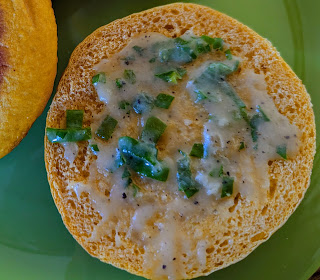
Also from Milk Street. I think this is plenty for 8 buns so I half it. I've also melted the butter when I've been in a hurry, however, this does cause the liquid to separate from the solids, somewhat.


1 stick of butter
3 T finely chopped fresh chives (in a pinch I've used scallions as well as finely chopped light-green leek leaves)
1 small garlic clove, finely minced
1/4 teas freshly ground black pepper

Use a rubber spatula to stir the butter until it is no longer a stick but a creamy mass of smooth butter. Add the chives, garlic, and pepper and stir to combine.


Wednesday, January 11, 2023

Orange Cranberry Scones

 This flavor combination would fit well during the holidays, but because the cranberries are dried, you can enjoy these scones any time. 


Print

Orange Cranberry Scones

Slightly adapted from https://cooking.nytimes.com/recipes/1023483-cranberry-orange-scones
Yields 9 scones


1 medium orange
1/4 c granulated sugar
2 1/4 c flour
1 T baking powder
1/2 teas fine salt
1/2 c unsalted butter, cold
1 c dried cranberries, roughly chopped
1/2 c buttermilk, cold
1/2 c cream, cold

for the glaze: 
1 c powdered sugar
4-6 teas orange juice (fresh from the zested orange is nice)
pinch salt

Preheat oven to 400 degrees.

Zest the orange. In a large bowl, use your fingers to mix the zest and the 1/4 c sugar together. Add the remainder of the dry ingredients and combine with a whisk. 

Grate the cold butter using a box cheese grater, then stir into the flour. Stir in the cranberries. Make a well in the center, and pour in the buttermilk and cream. Gently stir with a fork until the mixture creates a shaggy dough. 

Place the dough on a lightly floured surface, and pat into a 1-inch thick rectangle. Fold the dough in half, then pat it into another rectangle. Repeat the fold one more time, then pat the dough into a 7-inch square about 1-inch thick. Cut the dough into 9 pieces. 

Transfer the dough to a baking sheet lined with parchment paper, then brush the tops of the scones with some additional cream and sprinkle with a bit more granulated sugar. Bake until golden brown, 18-22 minutes. 

Make the glaze by mixing the powdered sugar with 4 teas orange juice and a pinch of salt. Add more juice until the glaze is a thick but pourable consistency. Let the scones cool for about 15 minutes before drizzling the glaze on.  


Tuesday, January 10, 2023

Sloppy Joes

"Mom, these are so much better than the sloppy joes at school."


Print

Simple Sloppy Joes

Adapted from https://cooking.nytimes.com/recipes/4203-sloppy-joes
Serves 12, with small appetites; my family of 6 with big appetites might have some leftovers

2 8-oz cans tomato sauce
1 c ketchup
3 T Worcestershire sauce
2 teas prepared yellow mustard
1 teas dry mustard
2 teas molasses
2 garlic cloves, minced
2 lbs ground beef
1 small onion, finely chopped
hamburger buns

Prepare the sauce: Combine the tomato sauce, ketchup, Worcestershire, mustards, molasses, and garlic in a saucepan. Add salt and pepper to taste and simmer over low heat while the meat is cooking. 

Heat a large skillet over medium high heat. Add the ground beef and cook until no longer pink. Place a paper towel or two inside a colander; then pour the meat into the colander, letting the fat drain. 

Cook the onion in the same skillet until the onion is translucent, stirring often, about 5 minutes. Add the sauce and the meat, then heat for a few minutes, stirring occasionally. Taste the sauce and adjust salt and pepper if needed. 

Toast the buns under a broiler, then fill and enjoy! 

The filling freezes well, for a make-ahead meal.


Wednesday, December 21, 2022

Sunchoke and Sausage Soup

I adapted this recipe from one I found on multiple internet sites. I'm not sure who to credit. I saw one post that claimed the soup was an attempt to copy a dish served at Vermillion Restaurant in Old Town Alexandria, Virginia.


print

Sunchoke and Sausage Soup

Serves 6

4 slices bacon, diced (it can be pork or turkey bacon)
1 pd sausage, turkey or Italian (if you have links, remove the sausage from the casings)
1 pd sunchokes (Jerusalem artichokes) peeled, halved and cut into 1/2-in slices
6 small white potatoes, peeled and halved 
3 stalks celery, diced
1/2 large onion
1 leek, white and light green parts, chopped
3 c fresh spinach or swiss chard, chopped
2 cloves garlic
1 quart chicken or vegetable stock
1/2 c chopped parsley
2 T chopped fresh basil
2 T chopped fresh oregano
1 pinch cayenne pepper
1/4-1/2 teas sweet paprika
salt and pepper to taste
1/4 c all-purpose flour
1 c water

Cook the bacon and sausage, onion, celery, leek in a large saucepan or Dutch oven until the bacon and sausage are browned and the onion and celery are softened. Add the sunchokes and potatoes and pour in the stock. Stir in the parsley, basil, oregano, cayenne, paprika, and salt and pepper. Bring to a simmer over medium-high heat, covered. Lower the heat to medium-low and cook slowly for 30 minutes.

Put the flour and the water in a small bowl or container and stir vigorously until no lumps remain. Pour into the soup and continue simmering, covered for 10 minutes. Stir in the spinach (or chard) and cook for an additional 10-15 minutes until the broth is thickened and the greens have wilted. 

Notes:

I harvest sunchokes when garden herbs have frozen. I have used dried oregano and basil as a substitute and it is still good. 

Consider brightening with lemon juice or a bit of wine vinegar.

Monday, December 19, 2022

Salmon with Rhubarb Sauce

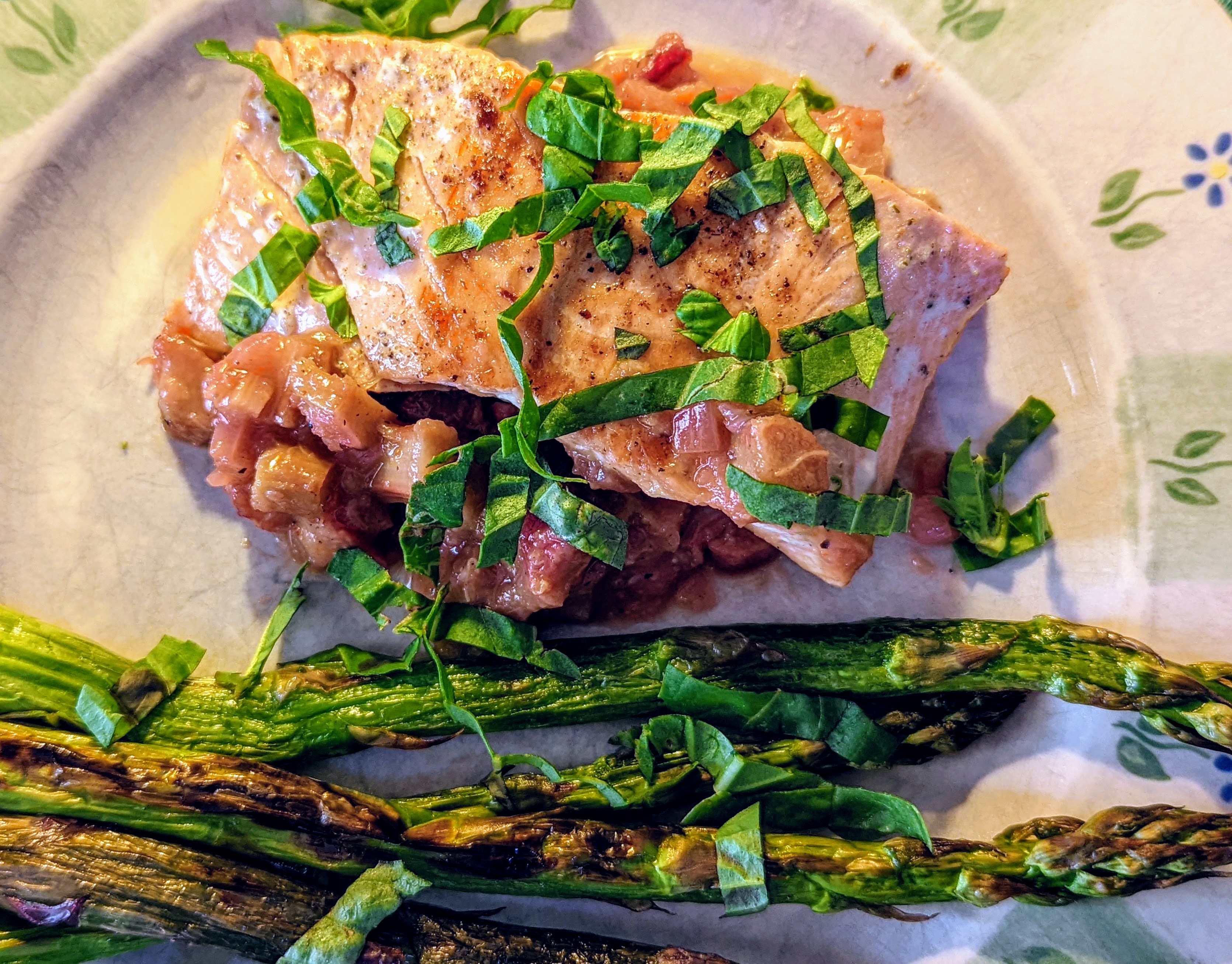
This dish seems more spring like, but because you can buy frozen rhubarb, it can be served any time. 


print

Salmon with Rhubarb Sauce


Source: Ellie Krieger
Serves 4

1 T olive oil
2 medium shallots, diced
1 1/2 inch piece ginger root, minced
8 oz rhubarb (red is the prettiest, but green tastes just as good), diced
1/4 c orange juice
1/2 c white wine
2-3 T honey
pinch of cayenne pepper
1/4 teas salt
1/8 teas freshly ground black pepper
4 6-oz salmon fillets, skinless if you prefer
1/3 c fresh basil leaves

Add shallots to heated olive oil in a 10-inch skillet or a medium saucepan. Cook until softened and add the ginger, cooking for about 30 seconds. Pour in the juice and wine; bring to a boil over high heat. Cook until the liquids have reduced by half and stir in the rhubarb. Reduce the heat to medium and simmer all until the sauce is thicker and the rhubarb has softened. Stir in the honey, cayenne and half of the salt. If the sauce is too thick, add a splash of water to loosen it a little.

In the meantime, heat up a skillet or a grill pan to cook the salmon. Heat to medium high and spray with cooking spray. Season the salmon with the remaining salt and pepper. Place the fillets in the skillet and cook for a total of 10 minutes per inch of thickness, flipping once, after the top has browned.

Cut the basil into ribbons and when the salmon is done, stir it into the sauce, except for a couple small portions for a garnish. Place about a quarter cup of sauce onto a serving plate and top with a salmon fillet and the garnishing basil.